

American Airlines Business Class Review: Auckland to Dallas (787-9)
Key Takeaways
- We booked this $6,000 American Airlines business class flight for just 109,000 points per person using Qantas—far cheaper than booking through American.
- The Boeing 787-9 seat and cabin (hard product) were modern, private, and comfortable for a 13+ hour flight.
- Service (soft product) was inconsistent and felt rushed, especially during boarding and breakfast.
- The Auckland and Dallas lounges offered excellent facilities, enhancing the overall travel experience ahead of and after the flight.
- Ultimately, the flight offers great benefits for those prioritizing nonstop travel and sleep, even if service disappointments occurred.
After more than 30 days of travel on our honeymoon—including flying the longest flight in the world—this was the flight that had to get us home comfortably. We chose a nonstop American Airlines Auckland to Dallas business class flight, and it’s a great example of how the right redemption can make or break a trip.
On a flight this long, seat comfort, sleep, lounge access, and service matter a lot more than usual. When you’re in the air for 13 hours or more, small details start to matter in a big way.

This trip was booked with points in a smart way, which made the whole thing feel like an even better win. We booked through Qantas points instead of American, and that ended up being a much better value for the exact same seat.
That said, this isn’t a glowing review. The Boeing 787-9 hard product had a lot going for it, including lie-flat seats, privacy doors, solid tech, and lounge access that helped on both ends, especially if you’ve seen other American Airlines Flagship Suites deals to Auckland. However, the soft product told a different story, with service issues that stood out more than they would on a shorter flight. So, if you’re thinking about booking AKL to DFW in business class, here’s what you’ll want to know before locking it in.
Table of contents
- How We Booked Auckland to Dallas Business Class With Points (American Airlines 787-9)
- Auckland Airport & Qantas Lounge Review Before the Flight
- Inside American Airlines 787-9 Business Class (AKL to DFW)
- Is American Airlines AKL to DFW Business Class Worth the Points?
- The DFW Flagship Lounge helped end the trip on a high note
- Conclusion
How We Booked Auckland to Dallas Business Class With Points (American Airlines 787-9)
This booking is a perfect example of why award travel is rarely about the airline on the tail alone. We flew American Airlines business class from Auckland to Dallas, but we did not book it through American. Instead, we used Qantas points to book the exact same flight, and that made a huge difference in value.
Flexibility helped a lot here. We already had another return option in place, but kept checking. When the nonstop AKL to DFW flight opened up, we switched. That meant a better route, less hassle, and a much better use of points on the Boeing 787-9.
Why booking through Qantas points was the better deal
The main reason was simple, the same American Airlines seat cost far fewer points through Qantas. Instead of paying about 287,000 American miles per person, the booking came out to around 109,000 Qantas points per person. That is a massive difference. While we do have a decent stash of AA miles, we don’t have any Qantas miles saved up, so this was all done by transferring our points from American Express to Qantas directly.
For two people, that meant about 218,000 points total plus roughly $160 in taxes and fees. The same trip would have cost around $6,000 in cash, so the value was strong.
| Program | Approximate cost per person | What stood out |
|---|---|---|
| American AAdvantage | 287,000 miles | Much higher pricing for the same seat |
| Qantas Frequent Flyer | 109,000 points | Better value for the exact same AA-operated flight |
This is one of the best lessons in points and miles. The same flight can cost very different amounts depending on which program you use. American and Qantas do not price partner flights the same way, and that can work heavily in your favor if you compare options before transferring points.
That’s also why transferable points are so valuable. In this case, moving Amex points to Qantas opened the better deal. If you want another example of Qantas pricing being useful on AA premium cabins, this other deal we posted using Qantas points for American Airlines business to London shows the same basic idea in a different market.
Auckland Airport & Qantas Lounge Review Before the Flight
Before a 13-plus-hour flight, the ground experience is important. If the airport feels chaotic, you start the trip tired before you even board. In Auckland, that part was refreshingly easy. The airport process moved well, the tech helped, and the Qantas Lounge gave this departure a much better start than a packed gate area ever could.
A smooth airport process made the departure less stressful


Auckland Airport was easy to figure out, and that alone was a big win before a long-haul flight to Dallas. Nothing felt confusing or needlessly slow.
A big part of what helped was the use of self-service tools and eGates. Passport scanning and electronic readers kept things moving, so the process felt modern and efficient. For travelers who qualify, facial recognition at immigration can also speed things up, which made the airport feel even smoother.
Because we were flying business class, we were also able to use the express lane at Auckland Airport, which made the entire process even faster.
The Qantas Auckland Lounge was a real highlight before boarding

The Qantas Lounge in Auckland was easily one of the best parts of the pre-flight experience. It felt large, open, and comfortable, which is exactly what you want before boarding a long American Airlines 787-9 flight. Instead of that cramped, overstuffed lounge feeling some airports have, this space felt airy and easy to settle into.
The Qantas Auckland Lounge is located in the international terminal, just after security and passport control, on the upper level above the main duty-free area.


The seating was a strong point. There was plenty of room, and the lounge never felt like everyone was packed together. Some seats were better for relaxing, while others worked well if you wanted to charge your devices or get a little work done before the flight. The layout felt thoughtful and practical.

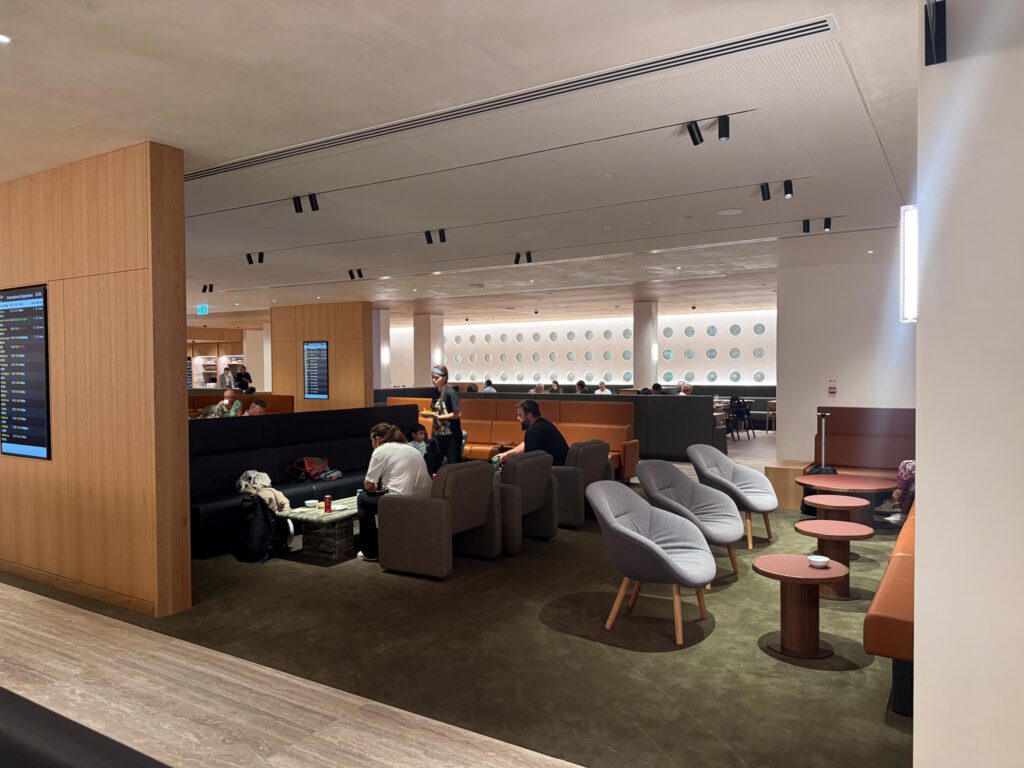
The design also helped. Natural light, greenery, and a bright open feel made the space feel calmer than the average airport lounge. It was the kind of place where you could actually sit down and reset for a bit.
Food and drinks were solid too. The lounge had a full bar, a decent food spread, and enough variety to feel like a real pre-flight meal.
Qantas Lounge Overview
- There was enough seating that it didn’t feel hard to get comfortable.
- The drink selection was good, including bar service and coffee options.
- The food was better than average for a departure lounge.
- The atmosphere felt calm, which helped set the tone for the flight.


There was also a separate dining section reserved for top-tier Qantas flyers. Even without that extra space, the standard business class lounge experience was already very good. For American Airlines business class passengers traveling on a Oneworld ticket, it definitely made the start of the trip more comfortable.
Inside American Airlines 787-9 Business Class (AKL to DFW)

Once onboard, this American Airlines Boeing 787-9 business class seat made a strong first impression. The cabin looked clean and modern, and the seat felt like a real step up from older business class products. If you’re booking AKL to DFW for the sleep and space, the hard product mostly delivers, even if the service side did not quite keep pace. Flighty told me that this plane was only 4 months old, and its newness certainly shined through.
Seat comfort, privacy, and layout, what the suite gets right


American uses a 1-2-1 layout on this Boeing 787-9, which means every seat has direct aisle access. Nobody has to climb over anyone else, and you can get up without bothering the person next to you.


The seat works well whether you are flying alone or with someone. If you are in a couple, the middle seats make it easy to talk. You are still side by side, so the flight does not feel split apart. If you are traveling solo, the window seats are the better pick. They feel quieter and more private.

The sliding door gives the suite a nicer feel too. It does not turn the seat into a private room, but it does create a little more separation from the aisle and the rest of the cabin.
Storage was fine, but not outstanding. There was room for the basics, like a phone, headphones, and a few small items. If you travel with a lot of gear, you may wish there was a little more space.


The first row was truly “Flagship.” It had more room, extra storage, and other features that gave it a more premium feel. If you can choose that row, it is probably the one to aim for.
The tech and small design touches felt premium


This is where the cabin really stood out. The main screen was large and sharp, and it felt much newer than the business class seats many travelers still picture when they think of American. It was easy to use and gave the seat a more polished feel.
The touchscreen remote was a nice touch too. Which helps when you are reclined and do not want to keep leaning forward, it is genuinely convenient.
Wi-Fi was available for $30 for the full flight or 3,800 miles, with a slightly cheaper two-hour option. On a flight this long, it made sense to just pay for the full pass

The tray table also worked well. It slid out from below the screen instead of swinging awkwardly from the side, or coming out of an arm rest. It was very adjustable in a lot of different directions, so you actually can exit your chair with the tray table extended if needed.


There were decent charging options, including wireless charging, though that part was a bit hit or miss for me. The headphones also felt like a proper premium cabin perk instead of an afterthought.
Sleeping, bedding, and comfort over a very long flight


For sleep, the seat did a good job. The lie-flat bed was easy to use, and it did not take any weird setup or seat gymnastics to get into bed mode. Unlike other lay-flat experiences, you don’t have to exit your seat to turn the chair into a bed, which is nice.
Once flat, the seat felt comfortable enough to get solid rest. The pillow was plush, and the seat pad or mattress topper added a bit more softness. The pajamas were a nice bonus too. Little things like that help the cabin feel more relaxed and less like a standard airline seat.


Privacy helped here as well. With the door closed and the cabin dark, it was easy to settle down and actually sleep. The business class bathroom was also more spacious than average, which was helpful for having room to change in and out of the provided pajamas.
Food, Drinks & Service on American Airlines Business Class (What Fell Short)


The weakest part of this flight was the soft product (service), not the seat or technology. To be fair, the food itself sounded and tasted decent to good overall. There was a full dinner service, mid-flight snack option, and breakfast before landing, so on paper, the catering checked the right boxes.

The issue was the execution. Boarding felt messy from the start, with the sense that everyone was brought on at once rather than a more organized premium-cabin process. One flight attendant started yelling at another one asking why so many people (beyond business class) were boarding when they hadn’t had a chance to even service business class yet.
That alone set a rushed tone, and it never really settled down. There was also a clear feeling that the crew wanted to get the flight out early (They kept saying “this crew is extremely motivated to get to Dallas early”), which made the experience feel hurried in a way business class usually should not.


That rushed energy showed up again before landing. Breakfast came very late, so late that some passengers barely had time to eat. One flight attendant, in almost a rude way, started yelling “Eggs or Fruit?” as he walked down the aisle slapping food in front of people, about 5 minutes before the landing process began.
In some cases, people did not even get drinks with the meal before the cabin was being prepared for arrival. You could hear the complaints. On a shorter flight, that might be a small annoyance. On a long-haul Flagship Business route, it’s kind of an issue.
Still, this did not feel like a reason to write off every American Airlines business class flight. It felt more like a new-route or crew-adjustment issue, especially since this aircraft and service pattern are still relatively fresh on this market. The hard product felt ready. The service just felt like it was still catching up.
Is American Airlines AKL to DFW Business Class Worth the Points?


This flight makes the most sense for travelers who care about time, sleep, and simplicity. On a route this long, the nonstop alone can be worth a lot. Add a modern 787-9 seat with a door, a true lie-flat bed, lounge access, and a strong points price through the right program, and you have a redemption that can be very easy to justify.
That said, this is not one of those flights where the premium label tells the whole story. The seat can be excellent while the service feels uneven. So the real question is not just, “Is it business class?” It’s, “Is this the right business class redemption for you?”
The best reasons to book this route in business class
If you hate extra stops, this is where the route shines. Flying Auckland to Dallas nonstop cuts out the airport shuffle, the reboarding, and that awful middle-of-the-trip slump where your body has no idea what time it is. For many travelers, that alone makes this flight much more appealing than a cheaper connecting option.
The hard product also gives you what most people want on an ultra-long-haul flight, privacy and sleep. The suite door helps the seat feel more tucked away, especially if you’re flying solo. Meanwhile, the lie-flat setup, plush bedding touches, pajamas, and decent tech make it easier to treat the flight like a recovery room instead of a survival test.
This route is a particularly good fit for:
- Solo travelers who want a quiet window suite with direct aisle access.
- Couples who prefer the middle seats and want to talk without feeling far apart.
- Points travelers who value a nonstop premium cabin more than chasing the flashiest airline.
- Anyone trying to arrive in the US in usable shape, not totally wrecked.
Booked through Qantas, this flight came in at about 109,000 points per person, instead of the much higher American pricing seen for the same seat. For a flight that can sell for around $6,000, that is a strong redemption, especially when taxes stayed low.
There’s also a practical side to this. If Dallas is just your gateway and not your final stop, the nonstop long-haul can still be the right move, especially if you know the trade-offs of separate tickets and onward travel. This guide to positioning flights for award redemptions is helpful if you’re piecing together the trip beyond DFW.
The DFW Flagship Lounge helped end the trip on a high note

After a flight where the seat impressed more than the service, the American Airlines Flagship Lounge in Dallas felt like a reset button. Once inside, the lounge felt big right away, and not in that cold, empty way. It felt open, comfortable, and built for people who actually need to spend time there.
The American Airlines Flagship Lounge at DFW is located in Terminal D, just past security near Gate D22 on the upper level.
Why the Dallas Flagship Lounge was one of the best parts of the trip


The food was the first thing that stood out. This was not the usual “grab a sad snack and keep moving” lounge setup. In the morning, there was a made-to-order omelet station, and later the lounge shifted into more substantial options, including a bulgogi station that felt far more thoughtful than standard buffet fare.
The food felt fresh, the options changed through the day, and the whole setup landed much closer to a restaurant-style lounge experience than a basic airline club.


Drinks were another win. Instead of waiting around for every little thing, a lot of it was self-serve, which made the lounge feel relaxed and easy to use. Champagne was everywhere, and that gave the space a celebratory feel without making it feel stuffy. If you wanted something simple and fast, you could just get it and move on.
The biggest advantage, though, was space. You want room to spread out, recharge your phone, change seats if you feel like it, and not spend hours guarding one small corner like it’s beachfront property.
Dallas Flagship Lounge Overview
- There was plenty of seating, so it never felt cramped.
- The food stayed interesting across different meal times.
- Drinks were easy to grab, which kept the experience low-stress.
- The atmosphere felt calm, even during a long wait.
There are lounges that do one thing well. This one did several. It fed you well, gave you room to breathe, and made Dallas feel less like a connection point and more like a soft landing. After a mixed onboard experience, that was a pretty great note to end on.
Conclusion
This American Airlines Auckland to Dallas business class review comes down to a simple split: the hard product delivered, but the service lagged behind. The Boeing 787-9 seat felt modern and comfortable, the cabin offered the kind of privacy you want on a flight this long, and the lounge access on both ends added real value. On top of that, booking through the right partner made the points side of this trip especially compelling.
If your main goal is a nonstop flight home with a solid bed, a sharp cabin, and a smarter award price, this route absolutely makes sense. It delivered where most points and miles travelers care most—sleep, comfort, and efficiency—even if the onboard execution did not fully match the Flagship Business label.
That said, expectations still matter. If you prioritize the nonstop route and the seat, you’ll likely walk away satisfied. But if you’re looking for highly polished, top-tier service, it’s worth going in with the understanding that the best part of this flight may be the product—not the crew.