
Symphony Savings Review: How the 5% APY, Travel Points and 100,000-Point Bonus Work
Disclosure and disclaimer: This article is for educational purposes only and is not financial, investment, tax or legal advice. BoldlyGo has an affiliate relationship with Symphony and may receive compensation if you sign up through our link. However, we accepted that relationship only after interviewing Symphony’s co-founder, asking direct questions about how the platform works and reviewing the available disclosures. An affiliate relationship is not a recommendation for every reader to open or fund an account.
Key Takeaways
- Symphony is a savings-first platform offering a 5% APY but is not a bank and lacks FDIC insurance.
- Users can earn cash or transferable travel points through various yield strategies, with an initial bonus of up to 310,000 points.
- Symphony uses cryptocurrency technology, converting deposits into USDC, a stablecoin pegged to the dollar.
- The platform offers several protections, but users should be aware that their principal is not guaranteed and risks exist.
- Symphony may appeal to those seeking to earn rewards while saving, but it is not suited for funds that require immediate access.
When Symphony approached us about a potential partnership, the concept immediately caught my attention. I am a points-and-miles enthusiast, but I am also a financial advisor by profession. A platform that allows you to earn transferable travel points while saving—rather than only when spending on a credit card—brings those two worlds together in a way few products do.
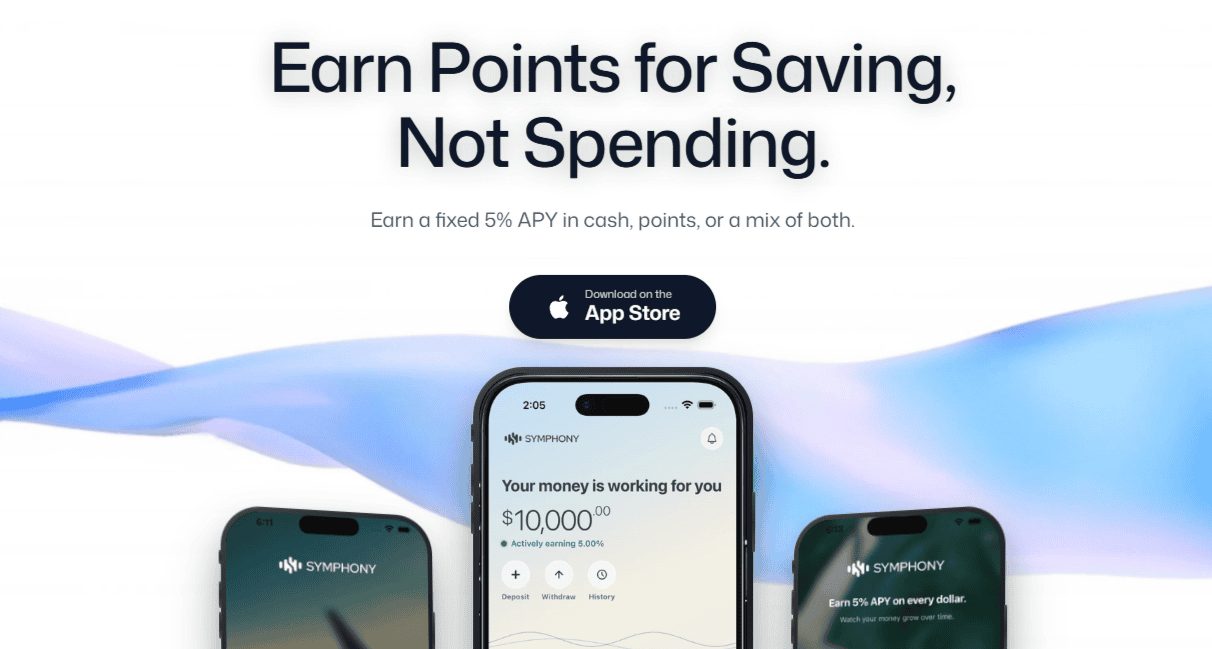
Symphony currently advertises a 5% APY, which you can earn as cash, Symphony points or a combination of the two. At first glance, that may sound like a high-yield savings account with a travel-rewards option. But Symphony is not a bank, and this is not a traditional savings account.
I wanted to understand how the platform worked, where the return came from and what protections and risks users would be accepting. As part of that process, I interviewed Symphony co-founder and chief business officer James Berry. You can watch our full conversation below, but this article explains what Symphony is, how its 5% return and points system work, the potential benefits and risks, and the current 100,000-point welcome offer so you can decide whether it fits your own financial situation.
Table of contents
What is Symphony?
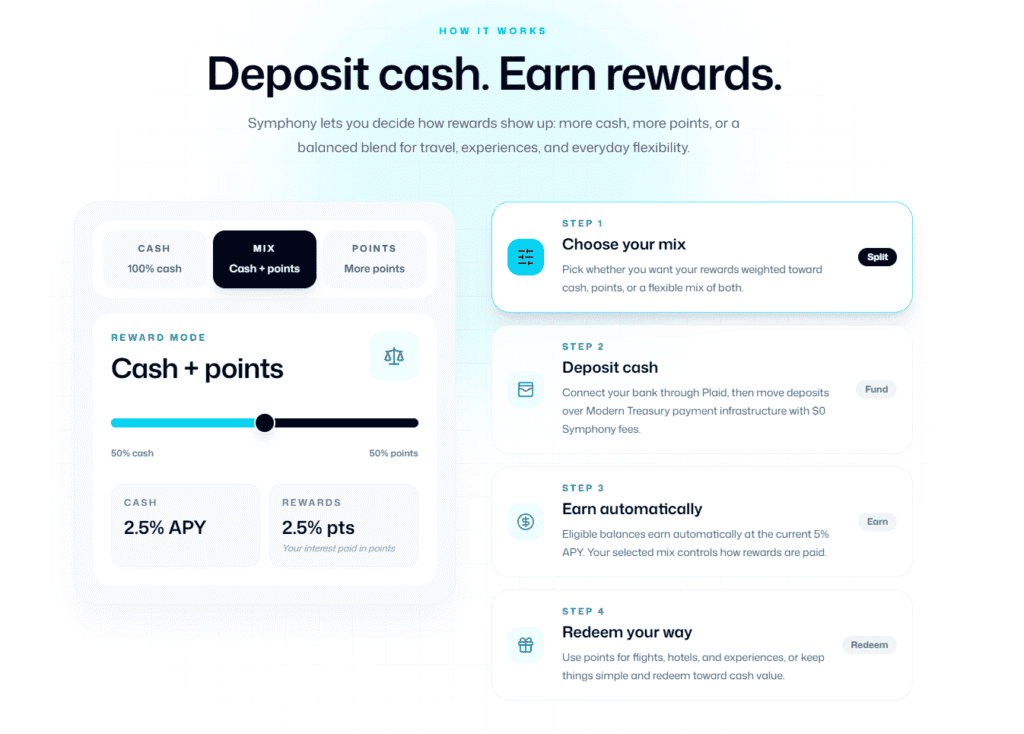
Symphony describes itself as a savings-first financial platform. You download the iOS app, verify your identity, connect a bank account through Plaid and transfer money over Modern Treasury’s payment infrastructure. Eligible balances are then routed to supported yield strategies. There are no current platform fees, minimum balance requirements, or minimum monthly transactions.
How the 5% APY and points work

The feature that separates Symphony from a standard cash account is the reward slider. You can choose:
- 100% cash interest
- 100% Symphony points
- Any mix of cash and points
At a full 5% allocation, a steady $10,000 balance would generate roughly $500 over one year before taxes, assuming the rate and balance stayed unchanged. Choosing points would produce roughly 50,000 points at Symphony’s displayed one-cent base valuation. The eventual travel value could be higher or lower depending on the transfer partner, ratio, award price, availability, taxes and carrier-imposed fees. Similar to having American Express, Chase, Bilt or other points, you’ll get more value out of your points by transferring them to their transfer partners. Base rewards accrue continuously and that points-based rewards compound in the same way cash interest does. You can also change the split for future earnings.
Is the 5% APY guaranteed?
During our podcast interview, Symphony co-founder James Berry told us the company expected to maintain the 5% APY for approximately 12 to 18 months, even if doing so required Symphony to supplement the portfolio’s returns from its own margin. Symphony’s website now describes the rate as fixed and says the company currently expects to maintain it for the next 24 months. However, its Terms of Service clarify that the displayed APY is a current estimate, is not legally guaranteed and may change. In short, Symphony has expressed its intention to continue offering the 5% APY for the foreseeable future, but users should recognize that the rate could eventually change.
Where does Symphony’s 5% return come from?
Symphony’s yield is generated from four main strategies rather than from new customer deposits or a short-lived marketing subsidy. In our interview, Berry estimated that private credit represented about half of the portfolio at that time, with the remainder spread across the other strategies and somewhat more weight toward Treasury bills and AAA credit. He also said the allocation can change.
| Yield source | What it means | Key Risks |
| U.S. Treasury bills | Short-term lending to the U.S. government, held through regulated brokerage infrastructure. | Interest-rate, custody and liquidity considerations; generally the lowest-risk anchor in the mix. |
| AAA-rated CLO exposure | The highest-rated layer of diversified corporate-loan pools; Symphony identifies the Janus Henderson JAAA ETF. | Corporate credit, market pricing and liquidity risk remain even at the highest rating tier. |
| Private credit | Short-duration lending backed by business receivables and other assets outside traditional bank channels. | Borrower defaults, valuation, counterparty and liquidity risk. |
| Overcollateralized lending | Borrowers pledge collateral worth more than the loan; collateral can be liquidated if required. | Smart-contract, protocol, collateral, liquidation, stablecoin and operational risk. |
Symphony transfer partners
Symphony points are designed to become transferable travel rewards, similar to points earned through programs such as Chase Ultimate Rewards, American Express Membership Rewards and Capital One Miles.
Symphony has announced that its first two transfer partners are expected to be:
- Turkish Airlines Miles&Smiles
- Avianca LifeMiles
Both programs belong to Star Alliance, which means their miles can be used to book flights on airlines such as United, Air Canada, Lufthansa and Singapore Airlines when award space is available. Symphony says transfers are expected to be offered at a 1:1 ratio, meaning 1,000 Symphony points would become 1,000 airline miles.
The company also plans to add one or two transfer partners each month, with a goal of offering approximately 12 to 15 airline and hotel partners. However, the full list has not been announced, and the first transfers were not yet available when this article was published.
The current Symphony 100,000-point welcome bonus


Symphony’s welcome offer has two separate parts: an automatic initial deposit bonus and an optional recurring deposit bonus.
The initial deposit bonus is based on the net amount you add during your first 30 days—eligible deposits minus any withdrawals. Symphony calculates your qualifying balance when that 30-day window closes and rounds it down to the nearest $1,000. The amount selected during setup is only an estimate; your actual activity during the first 30 days determines the bonus.


| Net deposits during first 30 days | Estimated initial deposit bonus |
|---|---|
| $1,000 | 1,500 points |
| $5,000 | 10,000 points |
| $10,000 | 25,000 points |
| $25,000 | 80,000 points |
| $50,000 | 160,000 points |
| $100,000 | 310,000 points |
The initial deposit bonus is not awarded all at once. It unlocks gradually over 12 qualifying monthly periods, and eligible withdrawals can reduce your qualifying balance. Symphony currently caps this portion of the offer at 1,000,000 points. So you can exceed well over 100,000 points.
New members can also enroll in an optional recurring deposit bonus during their first 30 days. You select one of three monthly deposit tiers:

| Recurring deposit tier | Potential bonus |
|---|---|
| $100 per month | Up to 2,000 points |
| $500 per month | Up to 9,925 points |
| $1,000 per month | Up to 25,000 points |
Your chosen tier remains the same throughout the program, and the points unlock as you complete 12 qualifying program months. Your total bonus depends on how much you deposit during the first 30 days, whether you make withdrawals, and whether you enroll in and complete a recurring deposit tier.
Is Symphony FDIC-insured?
No. Symphony is not a bank, and money placed in its yield strategies is not protected by FDIC insurance.
FDIC insurance typically protects eligible checking accounts, savings accounts and CDs if an insured bank fails. Coverage is generally limited to $250,000 per depositor, per bank, for each account ownership category.
SIPC protection is different. It may help recover eligible cash and investments that are missing if an SIPC-member brokerage fails. Coverage is generally limited to $500,000 per customer, including up to $250,000 for cash. However, SIPC does not protect you if an investment loses value.
What protections does Symphony offer?
Symphony describes three layers of protection:
- SIPC and additional brokerage coverage: Symphony says eligible Treasury and CLO investments are held through Alpaca Securities, a regulated brokerage firm and SIPC member. It also describes additional coverage through Lloyd’s of London, subject to certain limits and requirements.
- Nexus Mutual coverage: Symphony says its lending strategy has coverage for certain technology failures and problems involving the platforms it uses. This is private coverage, not government-backed insurance.
- Symphony’s reserve fund: Symphony says it also maintains its own reserve fund to help cover certain losses.
Each layer has its own rules, limits and exclusions. Symphony’s terms state that these protections may not cover every possible loss and may change over time. Your principal is not guaranteed, which means your balance could decline.
What happens to your money if Symphony fails?
Symphony says customer funds are not held in the company’s own corporate account or mixed with its operating money. Instead, each user receives a separate smart account with an embedded digital wallet. Users can export their wallet keys, while Symphony is given limited permission to move funds among the investment strategies available on the platform.
This is designed to help users keep access to their money even if Symphony shuts down or its app stops working. However, getting your money back could be more complicated than withdrawing from a regular bank account. Access may depend on your wallet information, Symphony’s financial partners, market liquidity, compliance checks and the technology networks supporting the account. Symphony also warns that lost or stolen wallet keys, user mistakes and some blockchain transactions may be difficult or impossible to reverse.
Symphony points are different from the money in your smart account. If the company closed, Symphony says it would expect to provide time to transfer the points or possibly convert them to cash. However, its current terms do not guarantee either option. The terms state that points have no cash or ownership value and may be changed or forfeited. For that reason, I would transfer Symphony points to a travel partner once I had a clear plan for using them rather than keeping a large balance on the platform indefinitely.
Is Symphony crypto?
Not exactly, but cryptocurrency technology does play a role behind the scenes.
When you deposit money through ACH, Symphony converts your dollars into USDC, a type of cryptocurrency known as a stablecoin. USDC is designed to maintain the same value as the U.S. dollar and allows Symphony to move funds through the payment systems and investment strategies it uses. As a customer, you still deposit and withdraw in U.S. dollars and generally do not need to buy, sell or manage USDC yourself.
However, USDC is not the same as money held in an FDIC-insured bank account. Symphony’s terms identify risks tied to stablecoins, blockchain networks, liquidity, regulations and the possibility that USDC could temporarily or permanently lose its one-to-one value with the dollar.
So, Symphony is not a traditional crypto-trading platform, but it does use cryptocurrency and blockchain technology as part of its financial infrastructure. If any crypto exposure is a dealbreaker for you, that is important to understand before opening an account.
My personal take after interviewing Symphony
I came away from the conversation encouraged by the concept and by Berry’s willingness to answer difficult questions. I like that the underlying return is tied to multiple income-producing strategies, that Treasury and AAA CLO holdings use regulated brokerage infrastructure, and that the smart-account design is intended to keep customer assets separate from Symphony itself.
I also would not place Symphony in the same category as an FDIC-insured savings account. In the risk pyramid I use when explaining financial choices, I would place it above bank savings and CDs: still designed to be relatively stable, but with more moving pieces and more ways an adverse event could affect value or access.
For my wife Taryn and I, the approach we would consider is a separate tranche of money—not our entire emergency fund, not money needed for a large purchase and not money that would replace long-term retirement investing. The appeal of earning points does not change the job each pool of money has in our plan. While we believe Symphony is worth explaining and potentially useful for the right person, we do not believe it is right for everyone.
FAQ
What is Symphony?
Symphony is a financial technology platform that lets users earn cash, transferable travel points or a mix of both on their deposits. It currently advertises a 5% APY, but it is not a bank or a traditional savings account.
Is Symphony FDIC-insured?
No. Symphony is not a bank, and money placed in its yield strategies is not protected by FDIC insurance. Some eligible investments may receive SIPC and other private coverage, but those protections do not guarantee your principal or cover normal investment losses.
Is Symphony a crypto platform?
Symphony is not a crypto-trading platform, but it does use cryptocurrency technology behind the scenes. Deposits are converted to USDC, a stablecoin designed to match the value of the U.S. dollar. Customers still deposit and withdraw in dollars and generally do not manage USDC themselves.
Is Symphony’s 5% APY guaranteed?
Symphony currently describes its 5% APY as fixed and says it expects to maintain the rate for the next 24 months. However, its Terms of Service state that the displayed APY is an estimate, is not legally guaranteed and may change.
How does the Symphony welcome bonus work?
Your bonus is based on your net deposits during your first 30 days, after subtracting any withdrawals. The points unlock over 12 qualifying months instead of being awarded all at once. You may also earn additional points by enrolling in an eligible recurring deposit plan. Review the current offer terms before depositing because requirements and bonus amounts may change.
Can you lose money with Symphony?
Yes. Symphony uses several investment and lending strategies to generate its return, and your principal is not guaranteed. Its protections may help in certain situations, but they do not cover every possible loss.
What happens to your money if Symphony fails?
Symphony says each customer’s money is held in a separate smart account rather than being mixed with the company’s operating funds. This structure is designed to preserve access if Symphony closes, but recovering your money could be more complicated than withdrawing from a bank. Access may depend on your wallet information, financial partners, market conditions and the technology supporting the account.
How quickly can you withdraw money from Symphony?
Symphony allows users to request withdrawals in U.S. dollars, but the timing can depend on the investment strategy, available liquidity, banking systems and any required security or compliance reviews. This may take longer than transferring money from a traditional savings account, so Symphony may not be ideal for funds you could need immediately.
Bottom line: Is Symphony worth it?
Symphony is one of the most interesting new products in the points-and-miles space because it rewards you for saving instead of spending. The current 5% APY, flexible mix of cash and points, compounding points and generous welcome offer give it real appeal—especially for travelers who already understand the value of transferable rewards.
But Symphony is not a traditional savings account. It is not FDIC-insured, your principal is not guaranteed and the platform uses several investment strategies, financial partners and digital-asset systems to generate its return. SIPC protection, private coverage and Symphony’s reserve fund may provide safeguards in certain situations, but they do not protect against every possible loss.
After doing our own research and speaking directly with Symphony’s leadership, we felt comfortable becoming an affiliate and considering the platform for a portion of our own savings. We would not view it as the place to keep every dollar or money we could not afford to lose. Instead, we see it as a potential option for a separate pool of funds for someone who understands the added risks and believes the points and 5% return are worth the additional complexity.
If guaranteed principal, FDIC insurance and the simplicity of a traditional bank account are your priorities, Symphony is probably not the right fit. If you are comfortable with how the platform works and want to earn transferable travel points without increasing your credit card spending, it may deserve a closer look.
Ultimately, the welcome bonus may get your attention, but the long-term decision should come down to whether you are comfortable with the product after the bonus is gone. If you decide Symphony fits your financial and travel goals after completing your own review, you can support BoldlyGo by signing up through our Symphony affiliate link.
Related posts:
 The Best Resorts in Roatan That You Can Book with Points
 ✈️ Fly Business Class to Europe Under $2,699 Roundtrip (Usually $5,000+)
 The Psychology Behind a Winning Points and Miles Strategy (And How To Put It To Work)
 Fly Emirates Business Class to Dubai from Just 110K Miles Roundtrip (Value: $8,000+)

Comments are closed.
2 Replies to “Symphony Savings Review: How the 5% APY, Travel Points and 100,000-Point Bonus Work”
Did you inquire how much venture and founder funding is in the business and how much more they anticipate raising near term? Running out of cash is a key risk that needs to be understood. During the interview I heard that someone is guaranteeing the 5% return over the near term, but there was no follow-up. It sounded like he said Elon, but wasn’t sure. Later he said they will forgo margin to ensure the 5% is maintained. I was left unsure of the answer.
Hello, no we did not get into those details. His comment about Elon was related to how he plans to roll out his 6% return with X, but that has nothing to do with Symphony.